Independent theoretical research
Deriving Relativity, Not Assuming It
Special relativity rests on two postulates. Beta asks what happens if you don't assume them — and instead recover Lorentz invariance, time dilation, and relativistic energy from a single geometric constraint on a fiber bundle.
β Beta Hypothesis
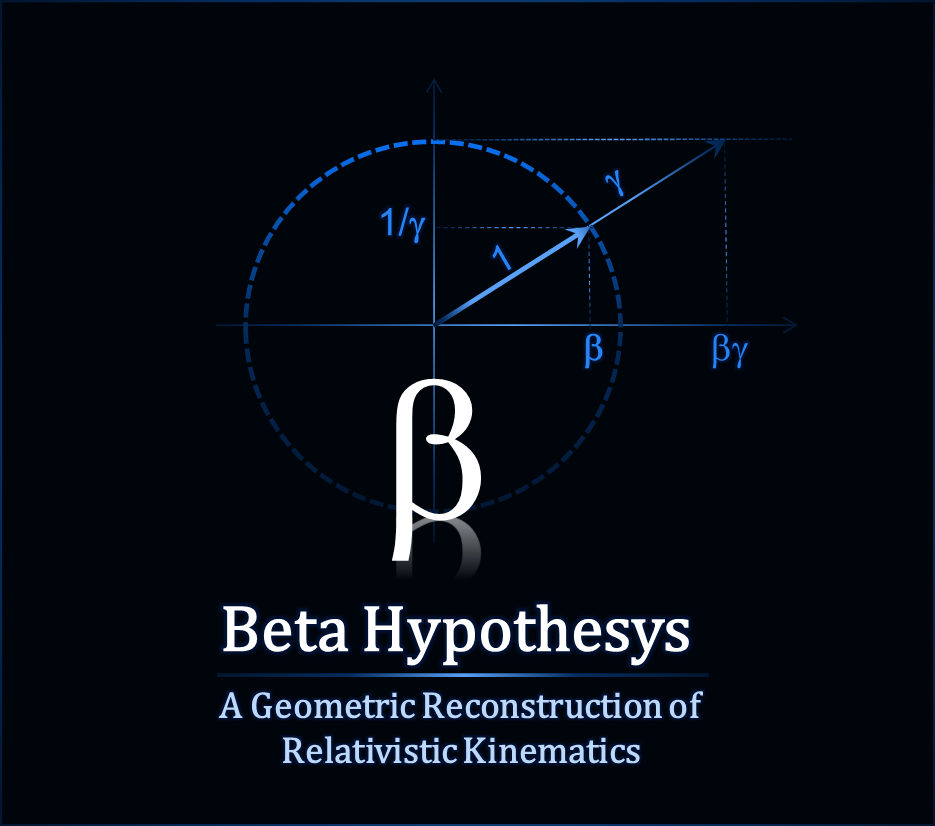
The Beta Hypothesis reconstructs relativistic kinematics — time dilation, length contraction, relativistic energy — from one local rule: a single wave, propagating at speed c on a fiber bundle, split between an observable direction and an internal periodic one. Lorentz invariance is not assumed. It follows as a consequence.
The structure is a bundle of the form D¹ × S¹: a one-dimensional observable base carrying a compact internal circle at every point. What we perceive as rest mass is internal vibration; what we perceive as motion and kinetic energy is the same vibration, partly redirected along the base.
Why Beta?
Most approaches take the Lorentz transformations as given and build outward from them. Beta inverts the logic: it starts from a single geometric constraint and asks how much of relativistic kinematics can be recovered as a consequence, rather than assumed. The constraint comes first; the familiar physics comes out the other end — and, in ongoing work, so do spin and electric charge.
Three Key Ideas
One vibration, two readings
Rest energy and relativistic energy are not separate quantities linked by a formula — they are the same internal vibration, measured in two different frames.
Mass from geometry
Rest mass is the frequency of an internal mode on a compact circle: m₀ = h/(cλ₀). Not an external parameter, not a Higgs coupling — a geometric fact.
Lorentz as consequence, not axiom
The Lorentz transformations emerge as the only way different observers, each using their own internal clock, can describe the same bundle consistently.
Latest Publication
Beta Hypothesis
Relativistic Kinematics as an Effect of a Geometric Constraint
Independent research by Alessandro Venca. Deposited on Zenodo for public priority; under submission to a peer-reviewed journal.
Scientific Discussion
This site presents ongoing theoretical work for scientific discussion, critical review, and comparison with related literature. The framework is offered as a foundational reformulation, not a claim of new predictions — its honest limits are stated openly. Feedback, objections, and pointers to related work are genuinely welcome.
Contact
Alessandro Venca
Independent researcher based in Switzerland
Email: venca.alessandro@proton.me